A National Primate Testing Facility Makes a Moral U-Turn
One of seven primate research centers is shrinking its colony and pivoting to alternative testing.
- Tamara Drake and Wayne Pacelle
A shift is underway in Oregon that may signal a broader movement away from primate use in biomedical research.
This week, the Oregon Health & Science University (OHSU) board of directors unanimously approved a new strategic framework for the Oregon National Primate Research Center (ONPRC), the largest of the seven National Primate Research Centers supported by the National Institutes of Health.
The resolution directs OHSU leaders to drastically reduce the center’s 4,500-primate population and to transition ONPRC toward becoming a national center of excellence for alternatives to animal testing, also known as New Approach Methodologies (NAMs).
This development comes after an unrelenting campaign by the Center for a Humane Economy and Animal Wellness Action urging change at ONPRC and the National Primate Research Centers (NPRCs). In May 2025, we articulated specific requests in a letter to NIH Director Jay Bhattacharya shortly after he assumed office. Last December, we collaborated with a bipartisan group of 20 concerned lawmakers who sent a letter to Dr. Bhattacharya, urging him to reassess funding for NPRCs and initiate a transformation change there. We also submitted public testimony to the OHSU board of directors in February this year, urging OHSU to convert ONPRC into a wildlife sanctuary and end its function as a breeding facility.
Now, ONPRC plans to move some primates to other institutions, reduce breeding as the colony declines, explore opportunities to transfer animals to sanctuaries, and focus future primate research on areas OHSU determines are unique to the center.
This change will not fully convert the facility into an animal sanctuary (as had previously been proposed), but the direction is unmistakable. One of the flagship institutions in America’s federally supported primate research system is preparing for a future with fewer monkeys — and a much greater emphasis on human-relevant research.
A Broader Federal Shift
Across the federal government, longstanding assumptions about the role of animals in biomedical research and drug development are being reconsidered.
The U.S. Food and Drug Administration has launched a roadmap to reduce animal testing in drug development and has issued guidance advancing the use of NAMs.
The National Institutes of Health has made human-based research a major scientific priority and, in March, announced more than $150 million to develop and scale methods that better simulate human biology and reduce reliance on animal models.
The NIH is also investing in standardized human organoid models and other technologies designed to provide more directly human-relevant information about disease and drug response.
The Centers for Disease Control and Prevention has moved to end its in-house monkey research program.
Congress is also scrutinizing the primate trade. Reps. Greg Steube, R-Fla., and Dina Titus, D-Nev., have introduced the Preventing Risky Importation of Monkeys to Avoid Toxic Exposures (PRIMATE) Act, which would prohibit the importation of nonhuman primates into the United States, with limited exceptions.
These changes pose the most serious challenge ever seen to the laboratory animal pipeline in America. We have been on the leading edge of these developments, from the enactment of the FDA Modernization Act (FDAMA) 2.0 in 2022, to the passage of its follow-up policy (FDAMA 3.0) by both chambers of Congress this year. And we will continue to be there every step of the way.
Charles River’s $510 Million Bet on Monkeys
The recent closure of Ridglan Farms in Wisconsin is one indicator that there is trouble ahead for those involved in testing on dogs. There’s also new legislation in the works to stop taxpayer funding for dog or cat experiments.
But change won’t come overnight. There are powerful crosscurrents seeking to halt our advance.
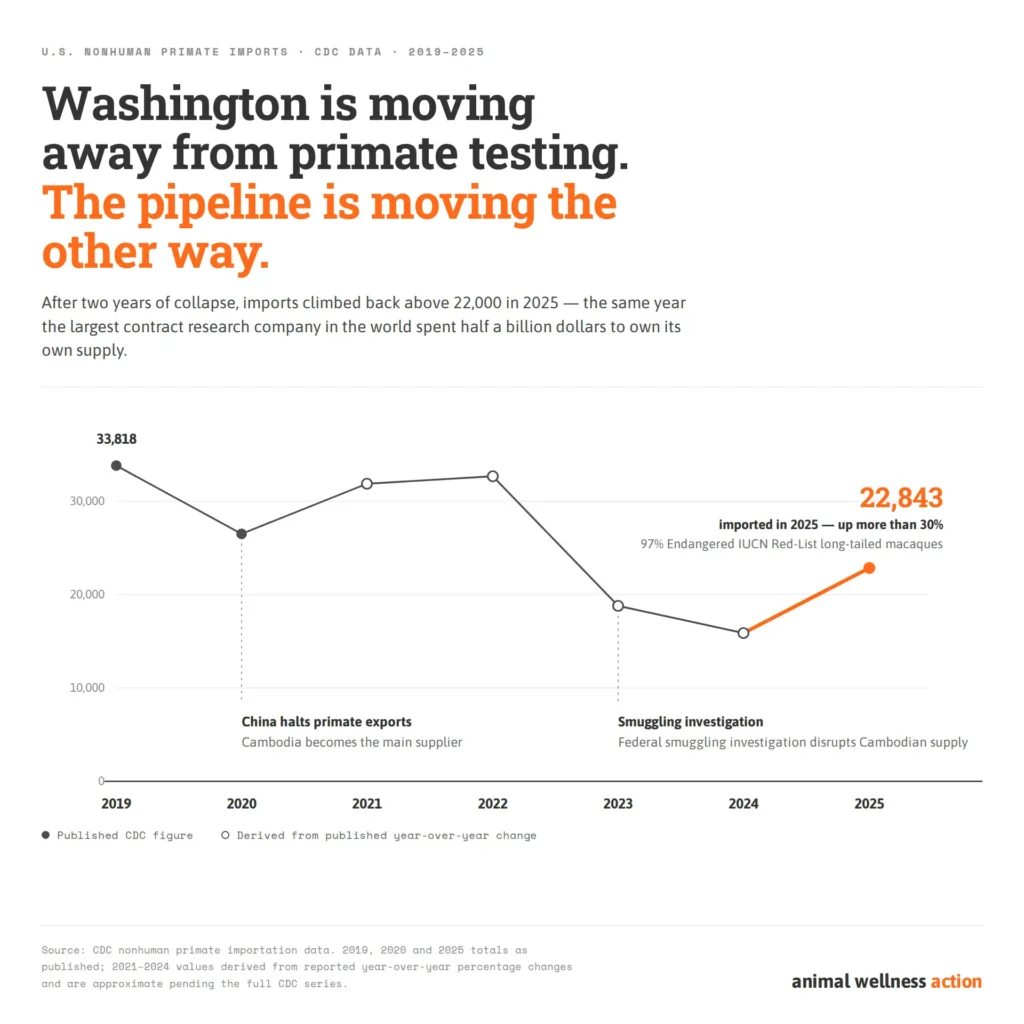
Earlier this year, one of the world’s largest contract research organizations, Charles River Laboratories, announced a half-billion-dollar deal to acquire the assets of K.F. (Cambodia) Ltd., a major supplier of long-tailed macaques. The publicly traded Charles River (NYSE: CRL) said acquiring the Cambodian company would allow it to strengthen and secure its primate supply chain while reducing costs.
With this move, Charles River, which already owns a 90% controlling interest in Noveprim, a major primate supplier in Mauritius, will now own and internally source most of the primates it expects to use every year. In other words, Charles River is vertically integrating the monkey pipeline.
This is an extraordinary commitment of capital to a research model that Health and Human Services Secretary Robert F. Kennedy Jr. has publicly said he wants to stop. “There are over 100,000 monkeys in primate testing labs around the country, with more than 20,000 more being imported every year,” Kennedy said in an interview on Fox News’ “My View with Lara Trump.” “We are trying to put an end to that.”
Secretary Kennedy’s strong stance on the issue is understandable when you consider that more than 97% of the primates we are importing are long-tailed macaques, a species classified as endangered by the International Union for Conservation of Nature. The global trade in the species is under intense scrutiny following allegations that wild-caught macaques in Cambodia were falsely represented as captive-bred before being exported for biomedical research. Charles River itself stopped shipments of Cambodian primates in 2023 while the U.S. Department of Justice and the U.S. Fish and Wildlife Service investigated the Cambodian supply chain.
The Scientific and Economic Costs of Primate Dependence
Primates are scarce and extraordinarily expensive, hawked for up to $50,000 each.
Nonhuman primates are frequently defended as research models because of their biological similarities to humans. But differences in immune signaling, receptor biology, metabolism, genetics, and gene regulation can produce substantially different responses to drugs and disease. And chronic stress can alter immune function, metabolism, cardiovascular responses, behavior, and other biological systems — the very systems researchers may be attempting to study.
Despite decades of reliance on animal testing throughout preclinical drug development, more than 90% of drugs entering human clinical trials still fall short of approval — underscoring the limitations of the animal testing paradigm in predicting human outcomes.
OHSU and Charles River are making very different bets on the future of biomedical research.
And that’s where we come in.
We’re taking on Charles River’s business model in the halls of Congress and in the boardrooms of other research institutions. And we are going to press the other regional primate centers to move in the direction of OHSU.
Congress can help by passing the PRIMATE Act and ending our nation’s dependence on imported research monkeys. The NIH can reallocate the hundreds of millions of federal dollars that sustain primate research, breeding colonies, and infrastructure. The FDA can accelerate its qualification of scientifically valid animal-free testing methods.
We must also confront a bigger question raised by what is happening in Oregon: If the largest one of the seven National Primate Research Centers can downsize its colony and redirect its mission toward animal-free NAMs, can’t the NIH develop a national strategy to help the other six centers do the same?
We need your continued engagement and help to make that happen. It’s up to all of us to ensure that science in the rest of this century is more zhumane than it was in the last one.
Tamara Drake is the director of research and regulatory policy at the Center for a Humane Economy. Wayne Pacelle, president of the Center for a Humane Economy and Animal Wellness Action, is the author of two New York Times bestselling books, “The Bond” and “The Humane Economy.”
Dear reader: If you support substantive policy work to protect animals, please consider donating to the Center for a Humane Economy today. You can give any amount one time, or make it a monthly gift, as many of our supporters do. Thank you for helping us fight for all animals. Please go here to make your contribution.
Originally published on the Center for a Humane Economy